In this article:
- What travel ERP airline API integration really means
- The Nexus Travels challenge
- What we built
- 7 proven lessons
- Technology approach
- Key takeaways
Travel ERP airline API integration is how modern agencies stop juggling airline portals, spreadsheets, and disconnected finance tools. When search, booking, customers, and accounts live in one system, agents move faster and managers trust the numbers. This case study explains how we approached travel ERP airline API integration for Nexus Travels-work I contributed to as part of the team at ninsols.com and the lessons you can reuse on thalnexus.com projects.
What travel ERP airline API integration really means
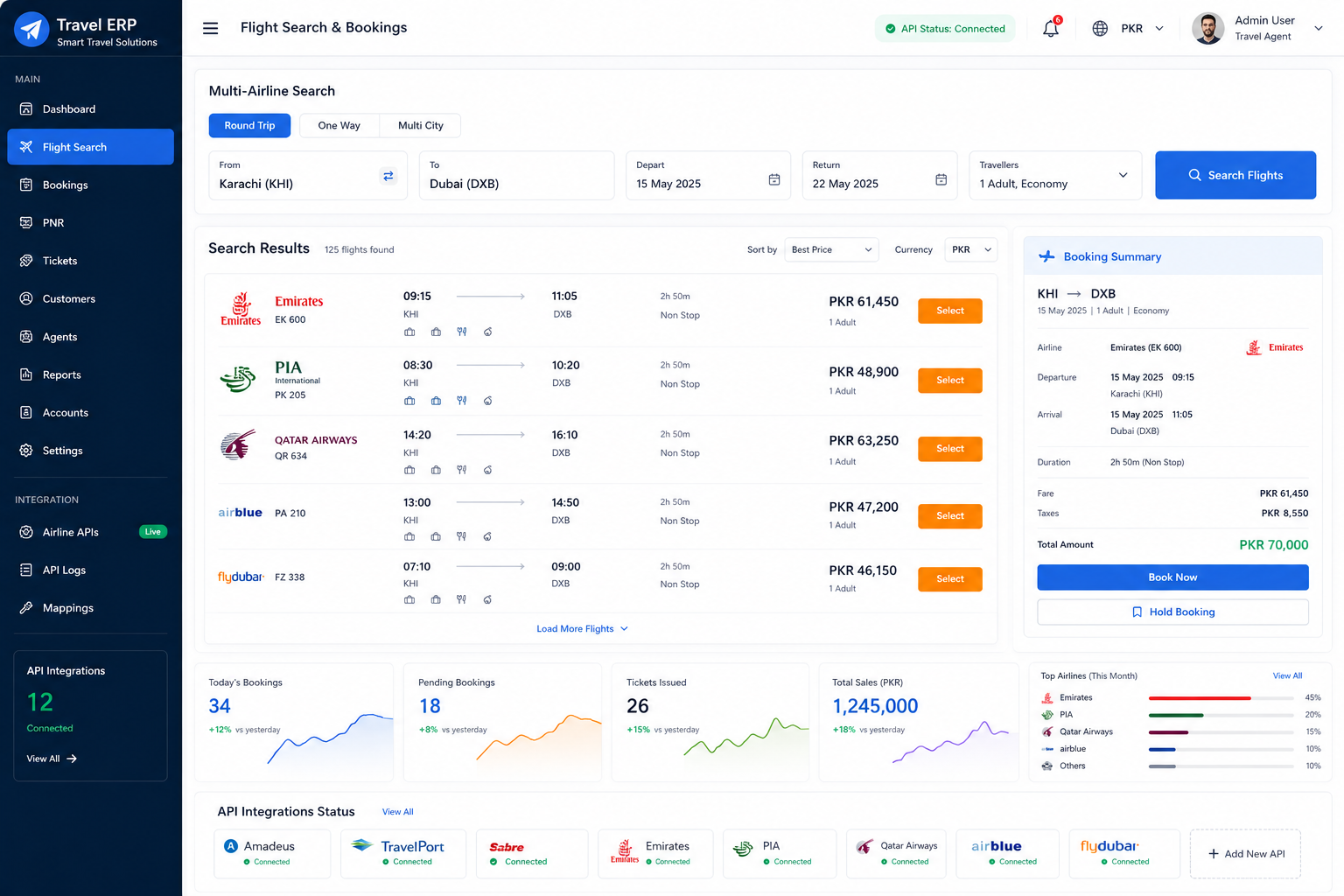
A flight search widget is not an ERP. Real travel ERP airline API integration connects live airline inventory to the full commercial day: reservations, passenger records, invoices, commissions, and reporting.
In practice, that means agents can compare fares, hold or ticket a booking, retrieve a PNR, and post finance without leaving the platform. If any of those steps still live on a separate portal, you still have process debt.
The business challenge at Nexus Travels
Nexus Travels needed end-to-end booking, customer, and invoicing workflows with live airline inventory. Staff should not open five carrier sites for one itinerary. Finance should not wait for end-of-day spreadsheet dumps. Operations should see reservation status without chasing ticket screenshots on chat.
The brief was simple to say and hard to build: one operational system for search, booking, customers, and money.
How we delivered travel ERP airline API integration
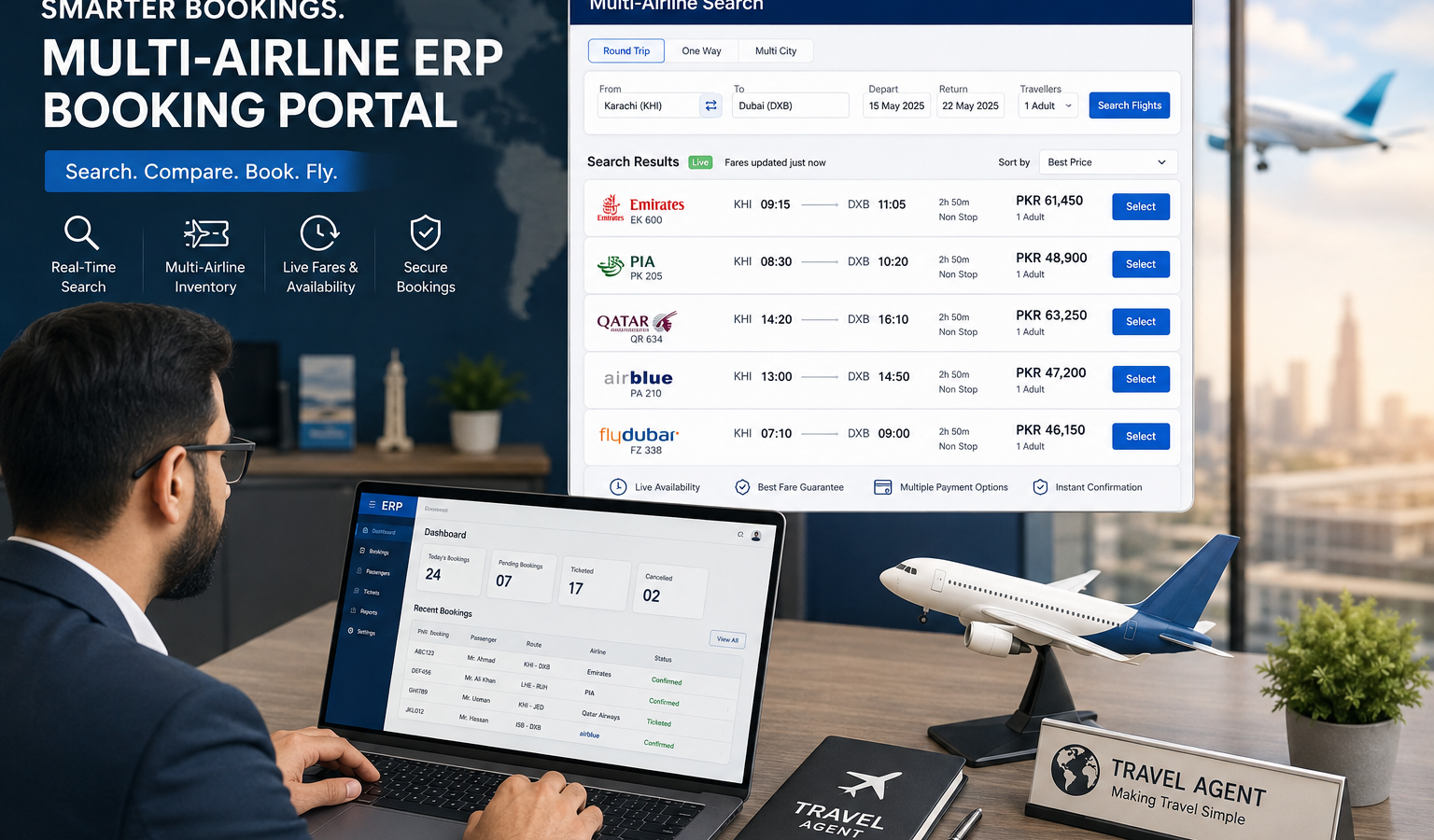
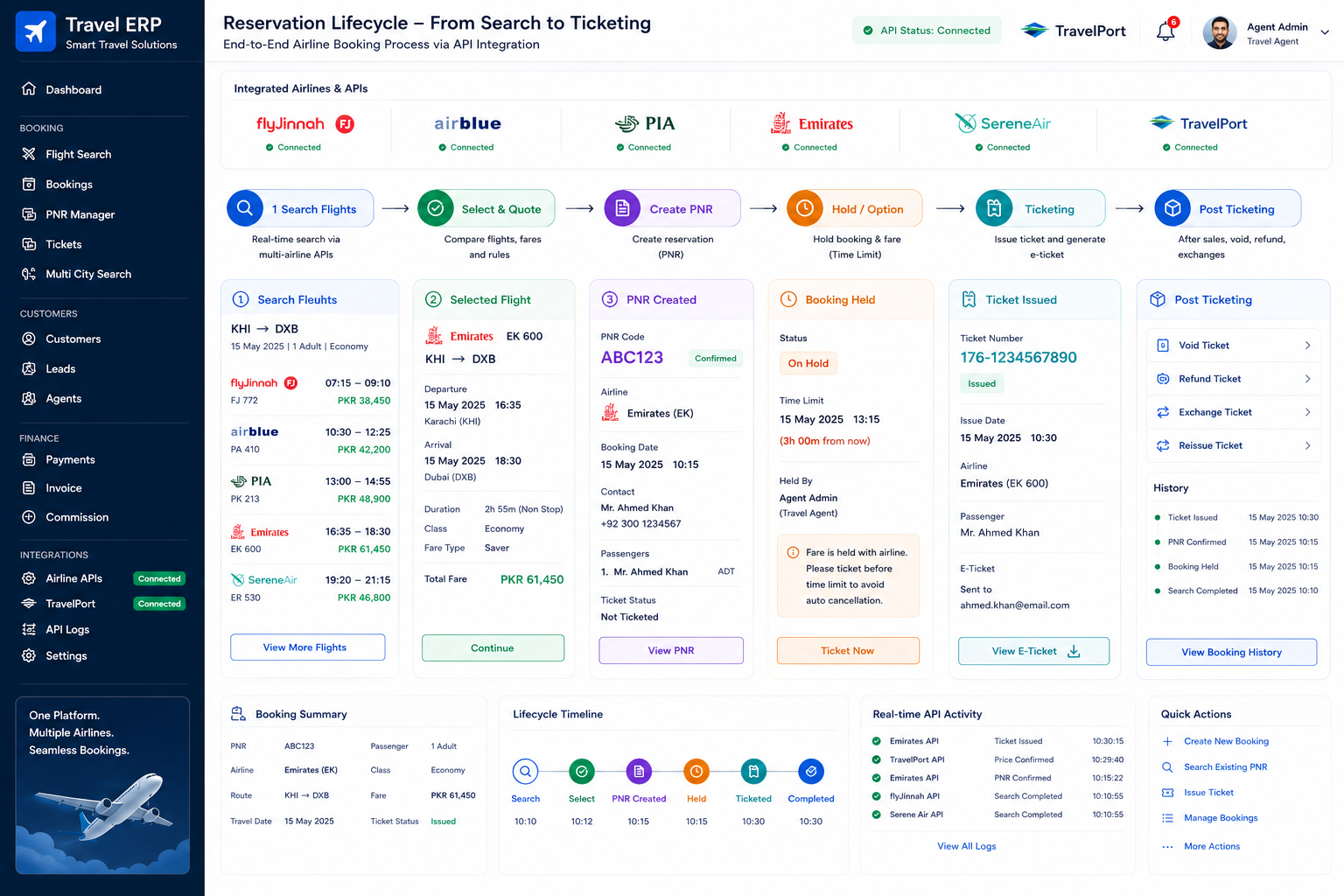
We delivered an ERP and booking portal that unifies multiple airline channels and a major GDS, then folds those bookings into CRM and accounting. That is travel ERP airline API integration in production-not a slide deck.
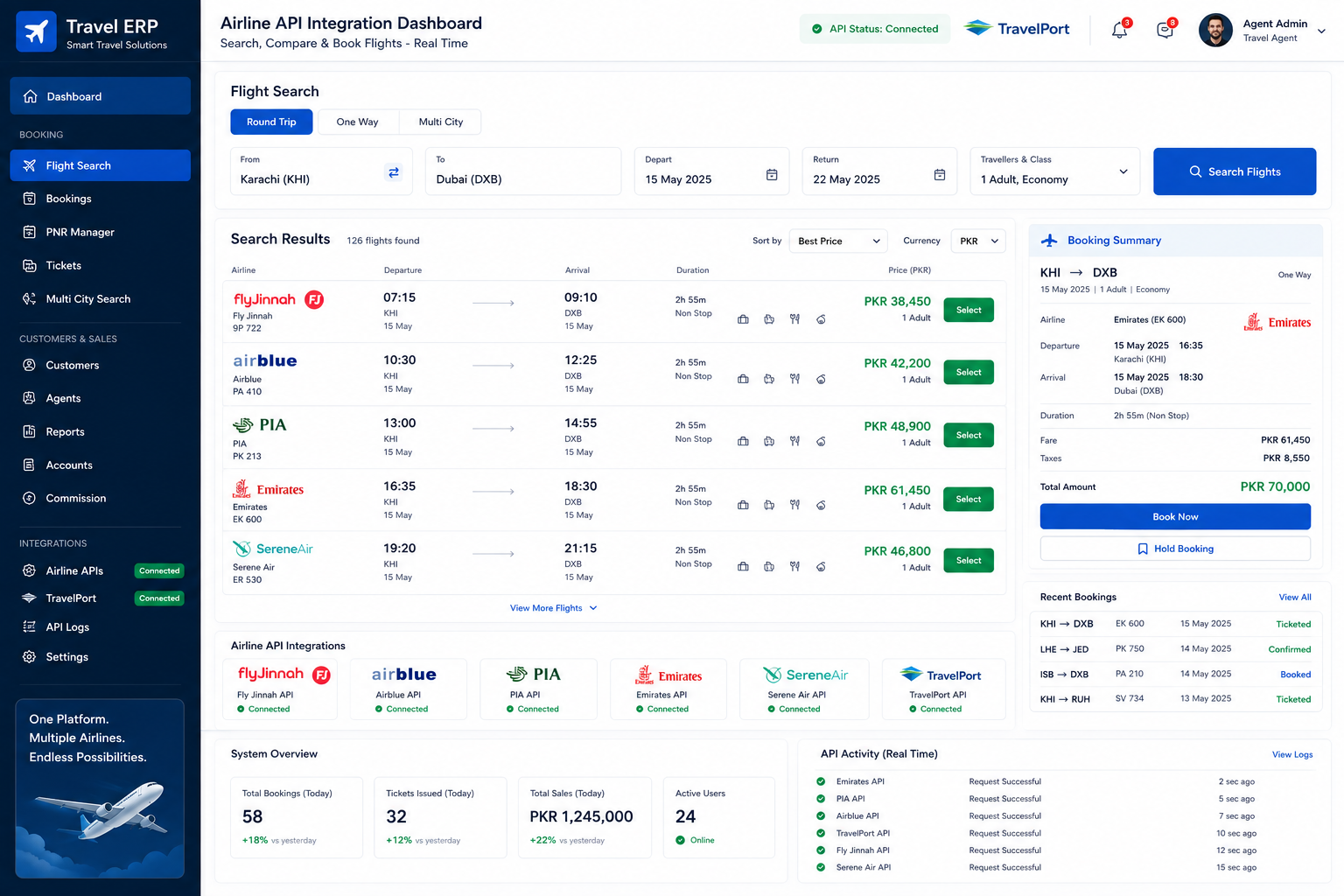
Airline and distribution connections included:
- FlyJinnah — live search and reservation flows
- Airblue — low-fare search and booking
- PIA — NDC shopping, order create, ticketing, seats, and ancillaries
- Emirates — NDC-style air shopping and booking
- Serene Air — NDC low-fare and order workflows
- TravelPort — GDS search, price, reserve, ticket, retrieve, and cancel
Beyond flights, the platform also supported hotels, insurance hooks, quotations, leads and tasks, multi-branch roles, invoicing, auto vouchering, and financial reports. Agents could search and manage reservations in one place while finance stayed connected.
NDC and GDS inside one agent experience
Successful travel ERP airline API integration usually needs both worlds. TravelPort-style GDS coverage helps with broad inventory and familiar agency flows. NDC-style carrier APIs (PIA, Emirates, Serene, and similar) often unlock richer offers and modern order handling.
Your product quality is not “how many APIs you listed.” It is how cleanly you normalize segments, taxes, baggage, errors, and booking status so the agent feels one workflow.
7 proven lessons from travel ERP airline API integration
1. Start from the agent’s day, not the API docs
Docs describe methods. Agents describe interruptions: a customer on the phone who needs a hold in twenty minutes. Design statuses and UX around that reality.
2. Budget serious time for data normalization
Every airline returns a different shape for fares, taxes, and failures. Travel ERP airline API integration succeeds when those shapes become one trustworthy model.
3. Build a booking lifecycle, not a single button
Production flows need search → price → passengers → hold/ticket → retrieve → cancel/void. “Book now” demos break the first time a fare disappears.
4. Treat finance as a first-class feature
If booking works but vouchers are manual, you shipped half a product. Service charges, commissions, invoices, and auto posting belong in the same design as search.
5. Log provider traffic like you mean it
When ticketing fails at night, request/response logs decide whether you fix it in minutes or spend two days guessing.
6. Plan multi-carrier architecture on day one
Even if you launch with two airlines, design merge search and reservation lists as multi-provider. Retrofits get expensive after invoices reference old booking IDs.
7. Keep roles, branches, and reports in scope
Agencies are multi-desk businesses. Access control and readable reports are part of travel ERP airline API integration, not “phase two nice-to-haves.”
Technology approach (kept practical)
The backend used ASP.NET Core with a layered architecture and SQL Server for operational data and reporting. Airline connectivity used provider APIs—including TravelPort uAPI and NDC-style services-with logging around external calls.
Stack choices matter less than operational honesty: clear booking states, reliable permissions, and finance hooks that do not depend on someone remembering to post a voucher.
Who this build pattern is for
This approach fits agencies and consolidators that sell across multiple airlines, want GDS plus direct/NDC connections, and need CRM and finance in the same system. It is less useful if you only need a marketing site that redirects to a third-party widget.
Team context and credibility
I contributed as part of the ninsols.com engineering team. Airline connectors, agency UX, and finance rules move in parallel on projects like this. Honest case studies perform better with clients and with Google because they match how real software ships.
On Thal Nexus, this article documents travel ERP airline API integration as shipped work-not a claim that one person built every screen alone.
Key takeaways
- Travel ERP airline API integration joins live inventory, reservations, CRM, and finance-not just flight search.
- Normalize NDC and GDS into one agent experience.
- Design the full lifecycle: hold, ticket, retrieve, cancel/void, ancillaries.
- Auto invoicing and vouchering turn a booking tool into an operations platform.
- Logging, roles, and multi-carrier design keep the system maintainable after launch.
Want help with a similar build?
If you are planning a travel booking engine, airline connectors, or agency ERP, I can help you scope the integrations and back-office flows agencies actually use. See more on thalnexus.com and the project page for Nexus Travels ERP & Booking Portal.
Built with the team at ninsols.com. Published by Thal Nexus.